Trump’s Scottish Golf Tour Hits a Wall of Resistance
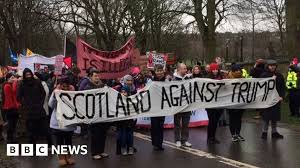
Former U.S. President Donald Trump’s return to Scotland has stirred a storm of protests, local discontent, and political frustration. While Trump prepares to inaugurate a new golf course at his Menie estate in Aberdeenshire, communities across Scotland are uniting in protest — not just against a golf course, but against what many now view as a legacy of broken promises, environmental destruction, and political posturing.
From environmentalists and trade unionists to long-standing local adversaries, the message is clear: Scotland is not rolling out the red carpet.
19 Years of Resistance Comes Full Circle
The Menie Dunes That Sparked a Movement
Rohan Beyts, an environmentalist who’s been at the forefront of opposition to Trump’s Menie resort since 2006, remembers the untouched beauty of the Aberdeenshire dunes. Once vibrant with butterflies and wildflowers, much of the legally protected landscape has now been reshaped under Trump’s “world’s greatest golf course” initiative.
Despite Trump’s grand $1 billion promise of a luxury resort that would replace jobs lost in the oil sector, many feel the development never truly delivered.
“Where’s the huge development? Where are the jobs?” asks Beyts. “I don’t understand how the politicians were so taken in.”
Trump’s broken development promises have left a lasting bitterness. Beyts, who once successfully challenged Trump International in court after being unlawfully photographed while walking on the property, now says she won’t join the protests — not out of support, but because “it plays to his ego.”
The Locals Who Wouldn’t Be Bought
David Milne’s Standoff Against Trump’s Empire
David Milne, another longstanding opponent, refused Trump’s attempts to buy and demolish his home. Trump called it a “visual slum”; Milne called it home.
Even after Trump sought a compulsory purchase order to remove him, Milne stood firm. His resilience has become symbolic of Scottish defiance.
On previous visits, Milne flew a Mexican flag in protest of Trump’s anti-immigration rhetoric. This time, he’ll fly the Scottish saltire. “His entire attitude was one of entitled arrogance,” he says. “And people up here have a habit of saying: ‘I don’t think so.’”
Milne also raises a financial objection: “Why is the UK taxpayer funding police for what is being called a private visit? This is a publicity stunt, and we’re footing the bill.”
Protests Expand Beyond the Golf Course
Peaceful Demonstrators Target Balmedie Beach
Tommy Campbell, a trade union leader, will lead a “festival of resistance” in Aberdeen city centre. On Tuesday, protesters plan to gather near the new course, writing messages in the sand at Balmedie Beach to visibly reject Trump’s visit.
“The world has changed since he first came to Aberdeen,” says Campbell. “People have seen through him, and he’s not welcome.”
He also criticized UK Labour leader Keir Starmer and Scottish First Minister John Swinney for agreeing to meet Trump during the visit. “They are not representing the true feelings of the Scottish people,” he says.
Turnberry on Lockdown
Trump’s Other Resort Brings Security Headaches
Across the country in Turnberry, Trump’s luxury golf resort is a fortress. Roads are blocked, police in high-visibility jackets patrol beaches, and checkpoints dot the countryside. Metal fencing surrounds the property, and transit vehicles trundle through tiny villages.
Some locals expressed anger at the “partial lockdown” imposed around the resort. One pensioner questioned why the government was paying for police deployments while cutting winter fuel payments for the elderly.
Others mentioned Trump’s contribution to local employment — but the tension is palpable.
Trump’s Motherland, Not a Homeland Welcome
Island of Lewis Sends a Message to the President
Menie’s new golf course is dedicated to Trump’s mother, Mary Anne Trump, who was born on the Isle of Lewis. But not even maternal ties have softened opposition.
In Stornoway, the island’s main town, Sarah Venus has re-hung a protest banner reading “Shame on you Donald John.” Ordered down by the council in May, the banner has now become a symbol of island resistance and is touring private homes.
Her frustration stems partly from Trump’s public shaming of Ukrainian President Volodymyr Zelenskyy during a White House press conference in February.
“People are beginning to connect the dots,” Venus says. “This is a transnational struggle against fascism. It’s not just happening over there in the US — maybe we can head it off here too.”
Politics, Protest, and the Cost of Ego
Public Money, Private Agenda?
Critics point to the irony of a “private visit” requiring massive public resources. The policing, security arrangements, roadblocks, and transportation costs are all publicly funded — despite Trump not holding any formal meetings or functions on behalf of the U.S. government.
Even as protests remain mostly peaceful and symbolic, there is rising frustration about whose interests are truly being served by this visit. Many see it as a photo op and soft marketing campaign for Trump’s re-election — one subsidized by the UK government and tolerated by its leadership.
Scotland’s Message Is Loud and Clear
From Aberdeen to Turnberry to the Isle of Lewis, Scotland’s resistance to Trump has only strengthened. What began nearly two decades ago as a local environmental dispute has evolved into a broader political statement: Scotland does not welcome Donald Trump — nor the ideology many say he represents.
Whether through handwritten protest signs, symbolic flag-flying, or messages etched in sand, Scots are speaking with unity and clarity. Trump may be visiting his mother’s homeland, but the reception is anything but familial.