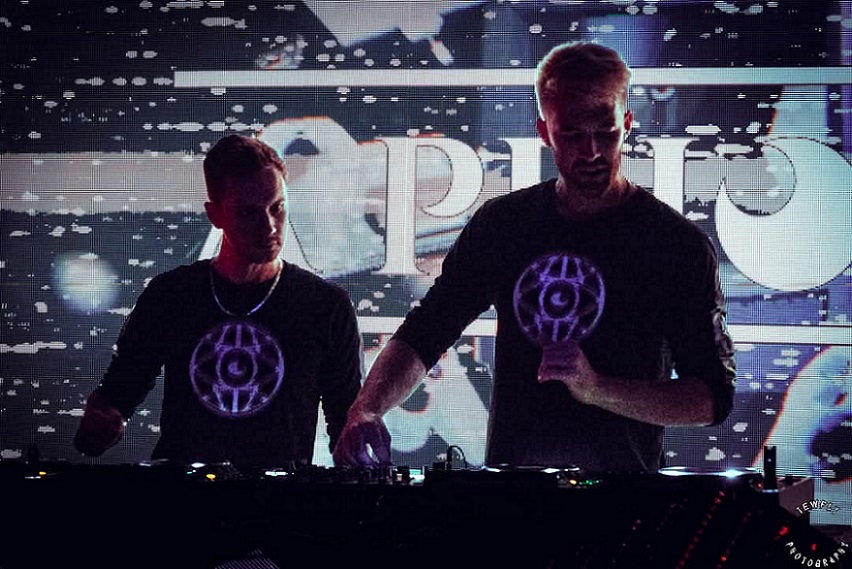
Today, we’re sitting down with A PRIORI, one of the most exciting up-and-coming talents in the Drum and Bass scene. With their unique blend of intricate beats, powerful basslines, and innovative production, A PRIORI is quickly making a name for themselves in a genre that thrives on energy and creativity. We’re excited to dive into their musical journey, creative process, and what’s next for these rising stars. So, without further ado, let’s get into the conversation with A PRIORI!
Q: What first drew you both to Drum and Bass, and how did you get started in the genre?
A: We were first inspired to learn production during the Midtempo Bass era, circa 2016-2018. We didn’t develop a proper appreciation for DnB until Joey saw the Worship Tour at a dingy underground venue in Vancouver, BC, where legendary artists 1991, Dimension, Culture Shock, and Sub Focus produced the most relentless, frenetic, upbeat energy he had ever seen. Then, after months of pestering Alex to try producing DnB, we opened for Reaper in 2022. We had never played a drum and bass set before, and the process of developing our setlist caused Alex to realize that he had been wrong for years – drum and bass is, without a doubt, objectively the best genre of EDM (and possibly music) to exist. At that show, Alex sang our debut DnB track ‘Ghost of You’ live at the end of our set, receiving a massive reception from the crowd. That was a lightbulb moment for us that reoriented our music to focus on drum and bass, with occasional forays back to dubstep and midtempo.
Q: Can you describe your creative process when it comes to producing a track from start to finish?
A: Most of our songs begin with Alex composing the basic outline of a track – melodies, synths, and structure. Though both of us are trained musicians and composers, Alex is the creative lead and primary songwriter. After the basic idea is composed, Joey prepares production notes with a focus on arrangement, sound design, and mixdown. Afterwards, we produce together for a number of sessions until the track satisfies both of us completely. We actually have lived in different cities for four years, so we work on Zoom using a plugin from AudioMovers called ‘Listento,’ which we sincerely recommend to anyone working remotely.
Q: How do you balance your individual artistic influences with creating a unified sound as a duo? A: We have been best friends for over a decade, and our friendship began as partners on our college debate team. As such, we started arguing with each other well before we started making music together. Our long friendship and mutual respect allow us to operate from a baseline assumption that feedback or disagreement derives from a place of emotional honesty and the pursuit of our common goals, rather than judgment or criticism. This allows us to argue constantly about every aspect of our music, brand, and business decisions without taking things personally. Through our debates, we have crafted a catalogue and persona which exemplifies both our preferences and highlights both our individual personalities. We trust one another enough to emphatically disagree about creative decisions and resolve the disagreements through discourse.
Q: What role does collaboration play in your music production? How do you ensure both of your creative visions are represented in a track? A: Our process for songwriting could be described as the pair of us constantly bickering and one-upping one another. Alex shells a track over the course of a day (often as a method of procrastination from answering emails), and sends it to Joey as a demo. When we sit down for collaborative sessions, we spend hours debating every minute detail of the track, from the overall flow and sound design to the pitch and timbre of the drum transients. Joey tends to be very detail-oriented, which combines with Alex’s focus on big-picture conceptualization and structure to allow the development of a song which expresses both our tastes and preferences.
Q: How do you approach live DJ sets differently from the production process? What’s your strategy for keeping the energy high and the crowd engaged?
A: In the early stages of our career, Joey would spend 40-60 hours on a setlist, finely tuning each transition until ‘each piece of the puzzle fit perfectly.’ Our modern performance style has moved away from perfectly-planned sets and placed a greater emphasis on reading the room and improvising. Instead of structuring the whole performance, we prepare 5-10 minute ‘mini-sets’ of various genres (which we regularly update with new releases, Soundcloud crate digs, and our own cheeky edits) and watch the crowd to determine what to play next.
We believe that a DJ should always serve the dance floor – our goal is, ultimately, to make sure people have a good time, and we constantly assess the crowd’s reactions to ensure that we give them a tailored performance suited to their needs. Most notably, our set style has developed around our live vocal performances. Our original tracks unequivocally receive the best reaction from crowds. We structure our live performances primarily around our songs, which often results in a more methodical, ‘concert’ style show. This style of performance has allowed us to adapt to a variety of showbills, and we have even opened for bands playing this way.
Q: Are there any specific DNB artists or producers who influenced your sound or career path?
A: We love the full soundscapes and cinematic composition of artists like Metrik, Camo & Krooked, Logistics, Mefjus, etc. (the Hospital Records-type sound). We’ve always loved music that elicits strong emotions in the listener, and these artists create worlds with their sound.
Also of note is Fox Stevenson, who is our role model for male vocals in DnB. His ability to produce and sing in a number of genres while maintaining his distinct, colorful style is a constant reference for us as we’ve developed our own sound over the years.
Blanke has been both a creative inspiration and mentor to us for years, and his productions for his AEON:MODE side project have provided a great deal of the sonic inspiration behind our dancefloor tracks. Blanke’s music was, in large part, what inspired us to start producing our own music in the first place, and we will both be die-hard fans to the end.
Recently, Phibes has been a great source of inspiration and mentorship for us as well. Scott was kind enough to take the time to sit down with us and listen through several of our upcoming tracks and provide detailed feedback to help us push them over the finish line. We absolutely love those guys, and have a huge amount of respect for them as producers and performers.
Finally, we have to shout out our mentor Jon Tho, who has taught us more about drum sound design and mixing than any other human being on the planet. Jon’s input gave our music the last little push it needed to really hit hard on the dance floor, and we’re excited to work with him more in the future.
Q: How has the rise of streaming platforms and digital production tools changed your approach to music creation and distribution?
A: We started our artistic journey well after streaming and digital production became the norms, so our strategy hasn’t so much “changed” as been molded by the tools at our disposal. Streaming services are designed to encourage smaller, more consistent releases instead of longer projects, so much of our energy has been dedicated to routinely releasing single tracks rather than devoting our time to more developed concepts. As consumers of music, however, both of us often prefer to listen to full-length albums over singles because longer projects provide a stronger insight into the mind of the artist, and generally provide a deeper and more interesting listening experience.
As of right now, we have enough singles ready for release to push at least one track a month for the next year, so our focus is shifting toward writing our first album because we want to develop a body of work that goes beyond short-term feeding of the algorithm and explores our creative and artistic vision on a deeper level.
Q: Drum and Bass has long been known for its underground culture. How do you view the commercialization of the genre, and how do you stay true to its roots while still appealing to a global audience?
A: We’re thrilled that the genre is attracting more fans. The more people exposed to DnB, the better! Of course, with mainstream popularity comes some degree of cultural dilution. Even as that happens, however, underground arenas both online and in person will always operate in parallel with their mainstream counterparts. For example, the longest-running DnB night in the USA happens in our hometown of Seattle, and we know we can always go there to hear the cutting edge of what the underground has to offer. Similarly, SoundCloud still is a goldmine for pioneers who are looking to push the boundaries of DnB experimentation. We’re open to sonic development of drum and bass as a medium, and we do hope that the live atmosphere of ‘nonstop energy from start to finish’ is received and adopted by new fans of the genre.
For our music, we like to continually experiment with DnB subgenres as a creative basis for new projects. One particularly funny example is a UK Grime-style jump-up track in which Alex raps (poorly). We shelved it for being a bit too silly, but we gleaned valuable production insights just from trying something new. Through experimentation, we gain respect for the musical values of various subgenres and learn ways to incorporate signatures from those genres into the tracks that do go out. Ultimately, our goal is to release on our all-time favorite labels like Hospital / Viper / UKF, and we extensively study and practice the styles of the giants who came before us. This allows us to incorporate our signature vocal performance and cinematic arrangements into a variety of more traditional sonic profiles.
Q: What is the most difficult part of balancing your artistic integrity with the commercial demands of the music industry, and how do you make those decisions without compromising your vision?
A: One concept that factors heavily into our writing process is the idea of how to make our music “cutting edge.” Plenty of music released today plays by the rules and norms within the genre, and just as much modern music breaks all norms in pursuit of novelty and innovation. We try to strike a balance between the two – crafting an innovative, unique sound while staying barely within the bounds of listeners’ expectations, just enough to allow our music to represent a fresh perspective rather than a complete overhaul of the listener’s tastes and preferences. The progression of tastes and preferences tends to be a gradual process, so our music combines the heavy-hitting aspects of DnB with a modernized take on vocal and instrumental performance from the grunge and post-grunge eras of rock music to expand our audience’s horizons while still providing what they need – solid music for the dance floor.
Q: Can you pinpoint a specific track or moment in your career that fundamentally changed the direction of your music, and how did that shift impact your creative process?
A: From a creative perspective, the biggest turning point in our career occurred the night after our first set at Bass Canyon in 2019. We had just finished playing a set at the after-hours silent disco, and the promoter (a friend of ours) walked over to us and said he had heard Alex singing along to some of the tracks in our set. He told us we needed to lean into Alex’s vocals as a production pillar, as this could help to set us apart. This event inspired us to write the song that eventually became Ghost of You, our first track featuring original vocals. Without this push, we may have never started producing songs around a vocal lead, and would be making drastically different music from what we now produce.
Thank you to A PRIORI for sitting down with us, make sure to check out their newest single “Bye Bye Bye” out now on Lithuania HQ!