Trump and von der Leyen Seal High-Stakes Transatlantic Trade Pact
In a dramatic breakthrough following four tense months of negotiations, US President Donald Trump and European Commission President Ursula von der Leyen have clinched a major US-EU trade agreement, averting a potentially devastating transatlantic trade war.
Announced from Trump’s Turnberry golf resort in Scotland, the agreement enshrines a 15% baseline tariff on most EU exports to the US—down from a threatened 30%, but still more than triple pre-Trump averages. The deal marks a sharp pivot toward stability, energy cooperation, and high-tech trade alignment between the two economic powerhouses.
What’s in the Deal?
Tariff Settlements — Higher, But Manageable
The centerpiece of the deal is the 15% baseline tariff on most EU exports to the United States. While higher than the 4.8% average under previous administrations, it’s a far cry from the 30% to 50% Trump had threatened in recent months.
Steel remains a sticking point, with a 50% US tariff continuing, though von der Leyen insists a quota mechanism will mitigate impact.
Pharmaceuticals were initially excluded, according to Trump. However, von der Leyen clarified that they are included at the 15% rate—with no guarantees that rate won’t change later.
Zero tariffs will apply to several strategic sectors, including:
Aircraft and components
Select chemicals and generics
Semiconductor equipment
Certain agricultural goods
Natural resources and critical raw materials
This mix of concessions and penalties appears aimed at balancing Trump’s “America First” narrative with global trade stability.
EU’s $1.35 Trillion Concession Package
In exchange, Brussels has agreed to a massive three-year package valued at $1.35 trillion, including:
$750 billion in US energy purchases: oil, gas, nuclear fuel, semiconductors, and liquefied natural gas (LNG)
$600 billion in direct investments into the US, including military equipment procurement
Trump has retained the unilateral authority to raise tariffs if the EU fails to meet these obligations—keeping pressure on Brussels long-term.
Diplomatic Theater at Turnberry
The deal was reached during a dramatic 40-minute meeting at Trump’s Scottish estate, with von der Leyen later describing the talks as “tough” and “very difficult.” Both leaders appeared tense in front of reporters prior to the closed-door session. Just an hour before the announcement, Trump rated the odds of success at “50-50.”
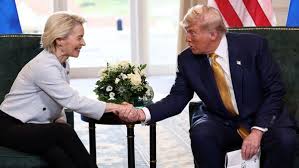
Ultimately, the two emerged smiling, shaking hands before a US-EU delegation that included:
US Commerce Secretary Howard Lutnick
US Trade Representative Jamieson Greer
EU Trade Commissioner Maroš Šefčovič
Key EU negotiators including Sabine Weyand and Tomas Baert
Von der Leyen praised the agreement as “a big deal, a huge deal,” while Trump called it “a powerful deal” that stabilizes “the biggest trading partnership in the world.”
What the Leaders Are Saying
Trump’s Take
Speaking to reporters, Trump hailed the agreement as a triumph of his tariff tactics and a “shot worth taking” for global commerce. He emphasized that the energy and semiconductor commitments represented “real buying, not promises.”
“It solves a lot of stuff. It was a great decision,” he said. “This is the biggest trading relationship in the world—we should give it a shot.”
Von der Leyen’s Response
Von der Leyen echoed optimism but admitted the EU had to bend more than it liked.
“You saw the tension at the beginning. We had to work hard to come to a common position. But this brings stability and predictability.”
Trade Commissioner Maroš Šefčovič conceded the EU had landed in a “worse position” on tariffs, but said the overarching goal was to avoid chaos.
“What was most important for us was to make sure we would have this predictability and we would have stability for our businesses.”
Reactions Across Europe
Germany Breathes a Sigh of Relief
German Chancellor Friedrich Merz welcomed the deal, particularly as it spares Germany’s auto-heavy economy from additional damage. German carmakers—VW, Mercedes-Benz, and BMW—had been hammered by Trump’s existing 27.5% tariffs on car imports.
“This deal averts a crisis that could have crippled our core industries,” said Merz.
Italy and Ireland Cautiously Optimistic
Italian Prime Minister Giorgia Meloni applauded the agreement’s stability but flagged the need for more clarity, especially on sector-specific tariffs. Italy, with a €40 billion trade surplus with the US, has much at stake.
Irish Deputy Prime Minister Simon Harris expressed “regret” over the 15% rate but accepted that “certainty” was better than chaos.
“Over the coming days, we will be examining what has been agreed and the full implications for Irish business,” he stated.
Notably, the agreement also creates a tariff discrepancy on the island of Ireland, where Northern Ireland traders will pay only 10%, risking tension with the Good Friday Agreement.
UK Left on Sidelines—for Now
Despite earlier signals from Trump that UK steel tariffs would be cut to zero, 25% duties remain in place. British Prime Minister Keir Starmer is set to meet Trump in Scotland this week in hopes of negotiating further concessions.
“There’s room to build,” said a UK official. “The EU deal sets a precedent, not a ceiling.”
Market Relief and China Hopes
Financial markets are expected to rally following the announcement. The deal ends months of uncertainty, during which global investors had feared a full-blown tariff war between the world’s two largest economies.
Further buoying optimism, Trump also hinted that progress is near on US-China trade talks, with a 90-day extension to the tariff pause reportedly in the works. If confirmed, the extension would delay tariffs until after the August 12 deadline—giving Beijing and Washington more time to negotiate.
Last week’s rally on news of a Trump-Japan trade deal now appears part of a broader US strategy to stabilize global markets ahead of the November election.
A Win, But With Strings Attached
Trump’s Turnberry deal avoids a worst-case scenario—but also marks a stark shift in global trade norms. The US has secured massive energy commitments and tariff leverage while Europe walks away with a somewhat bruised but functioning trade framework.
With critical sectors protected, and massive dollar flows heading into US industries, this agreement sets the tone for a new era of conditional globalization, where tariff threats are not just bargaining tools—but actual policy levers.
For now, CEOs and investors alike can exhale. But as von der Leyen and Šefčovič both hinted—this peace may come with a ticking clock.