Trump’s Scotland Sojourn Sparks Nationwide Protests
Former U.S. President Donald Trump is set to arrive in Scotland on Friday for a five-day “private” visit to his luxury golf properties. But while he comes to unwind at Turnberry and Menie Estates, the country is preparing for something far less relaxing: a wave of organized resistance.
With protests planned from the streets of Edinburgh to the shores of Ayrshire, the visit is shaping up to be one of the most politically charged private visits Scotland has hosted in years.
Why Trump’s Visit Is So Politically Volatile
A “Private” Trip with Global Implications
Although this is not an official state visit, Trump’s arrival in Scotland carries diplomatic weight. He is expected to meet Prime Minister Keir Starmer on Monday—a meeting shrouded in ambiguity. There will be no joint press conference, but both U.S. and UK media outlets are expected to be present for opening remarks, raising the possibility of yet another off-script Q&A from the former president.
Starmer, who will be fresh off the Women’s Euro final in Switzerland (assuming scheduling doesn’t change due to a potential White House dinner), is treading a delicate path: engage with Trump to preserve transatlantic pragmatism, while avoiding any optics of validation.
Tensions Rising Over Trump’s Radical Rhetoric
Since Trump’s last visit in 2018, his political positioning has shifted even further rightward. Policies once considered fringe—like mass deportations and total immigration bans—are now central to his platform. Scottish protestors are determined to make it clear: these views are not welcome here.
Protests Expected Across Scotland
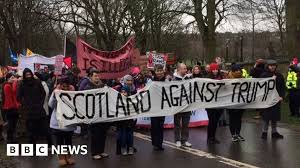
From Edinburgh to Aberdeen—Thousands to March
The Stop Trump Coalition has announced large-scale protests scheduled for Saturday in both Aberdeen’s city centre and outside the U.S. consulate in Edinburgh. Similar gatherings in 2018 drew thousands, and organisers expect a similar, if not larger, turnout this time.
Connor Dylan, a lead protest organiser, said:
“The vast majority of people in Scotland were already opposed to everything Trump stood for when he first visited. As we’ve learned more and more about him and the way he governs, that attitude has only hardened.”
Protests will also occur near Trump’s golf resorts, including at Turnberry and the Menie Estate in Aberdeenshire, where Trump is expected to unveil a new 18-hole golf course named in honor of his mother, Mary Anne MacLeod Trump—born on the Isle of Lewis.
“Widespread Anger” and a Demand for Accountability
According to Alena Ivanova, another protest organiser, there’s a “widespread anger and determination” among Scots:
“People across the country are calling on our elected leaders not to give Trump the acknowledgement and welcome he wants.”
Police Brace for Logistical Challenges
A “Significant Operation” for Scottish Police Forces
While Police Scotland has insisted there is “no expectation” of disorder, senior officials are calling the security effort one of the most complex in recent memory. Assistant Chief Constable Emma Bond, who is heading the operation, described a “positive and engaged” approach to facilitating lawful protest.
However, rank-and-file officers paint a more strained picture. The Scottish Police Federation has warned that resources are already stretched and the Trump visit could “double the time” it takes to respond to unrelated incidents across Scotland.
Ch Supt Rob Hay, president of the Association of Scottish Police Superintendents, confirmed that the operation would stretch across “many days” and “undoubtedly stretch all our resources from local policing divisions to specialist and support functions.”
What Starmer Stands to Gain—or Lose
A Balancing Act with Global Optics
The private nature of Trump’s visit puts Keir Starmer in a tight diplomatic spot. While Downing Street has insisted normal protocols don’t apply, optics still matter. Trump remains a powerful political figure in the U.S., particularly as he leads polls for the 2026 Republican nomination.
Should Starmer engage too enthusiastically, he risks alienating his progressive base and inviting criticism from civil rights groups and EU-aligned policymakers. If he’s too cold, he could jeopardize UK-U.S. relations—especially if Trump returns to the White House.
Media Opportunity—or Minefield?
Given Trump’s penchant for unfiltered commentary, the brief media availability ahead of the Starmer-Trump talks could produce major headlines. The last time they met, at the G7 in Alberta, Trump opined freely on tariffs, Ukraine, and his “affection” for the UK’s new leader.
The possibility of off-the-cuff remarks on NATO, the EU, immigration, or even the UK’s own political climate could make Monday’s session a diplomatic minefield.
Trump’s Golf Resorts and Their Political Symbolism
Turnberry and Menie—Luxury with a Message
Trump’s choice to stay at his own Scottish golf resorts sends a message: his business empire and his political ambitions remain tightly linked. The unveiling of the new golf course dedicated to his mother is not just a personal tribute—it’s a branding exercise.
His mother’s Scottish roots have long been part of his political narrative. In 2016, he repeatedly referred to his “Scottish heritage” when discussing Brexit, immigration, and nationalism. The new course is a soft power play—a way of physically embedding himself into Scottish soil, despite mounting public opposition.
Protests, Diplomacy, and the Power of Perception
Donald Trump’s visit to Scotland is officially “private,” but nothing about it will be quiet. From street demonstrations to behind-closed-doors diplomacy, the trip will test the UK’s political judgment, police resilience, and public patience.
For Keir Starmer, it’s a high-stakes moment of quiet diplomacy. For Trump, it’s another chance to command the spotlight. And for the Scottish people, it’s an opportunity to make clear—once again—that Trump’s brand of politics faces no silent acceptance north of the border.