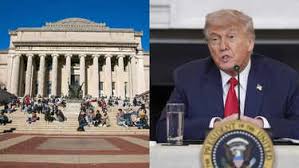
A University Once Known for Free Speech Now Faces Accusations of Censorship and Capitulation
Columbia University is at the center of a growing storm after agreeing to a $200 million settlement with the Trump administration—an agreement that has sparked fierce backlash across academia and led to the withdrawal of one of its most prominent voices.
Rashid Khalidi, the Edward Said Professor Emeritus of Modern Arab Studies at Columbia, announced that he is cancelling his planned fall lecture course, calling the university’s deal with Trump’s federal government a “capitulation” that compromises academic freedom and silences dissent. His open letter, published in The Guardian, is already reverberating across American campuses, reigniting concerns about political interference in higher education.
The $200 Million Settlement That Sparked the Controversy
Trump’s Pressure Campaign on Academia
In June, Columbia University reached a sweeping settlement with the federal government after the Trump administration accused it—and other elite academic institutions—of failing to combat antisemitism on campus amid rising tensions over the Israel-Gaza war. The administration’s threat was clear: comply or risk losing millions in federal funding.
The deal, now finalized, obliges Columbia to:
Pay over $200 million in penalties.
Submit to oversight by an independent monitor who reports to the federal government.
Expand its Institute for Israel and Jewish Studies.
Conduct a sweeping review of its Middle East curriculum.
Curtail programs deemed to promote “unlawful diversity efforts.”
Pay $21 million to the Equal Employment Opportunity Commission (EEOC) over alleged civil rights violations involving Jewish faculty.
This marks a significant shift in how federal oversight intersects with university governance, especially on politically charged issues like the Israeli-Palestinian conflict.
Rashid Khalidi: “This Is an Anti-University Now”
A Professor’s Protest Goes Public
Rashid Khalidi, who taught at Columbia for over two decades, had planned to return this fall as a special lecturer. But the terms of the university’s agreement with the federal government proved too much for him to stomach.
“I cannot do so under the conditions Columbia has accepted by capitulating to the Trump administration,” Khalidi wrote in his Guardian op-ed.
“Columbia’s capitulation has turned a university that was once a site of free inquiry and learning into a shadow of its former self.”
In a sweeping critique, Khalidi said the agreement:
Erodes academic freedom by allowing outside monitors to review course syllabi and scholarly materials.
Conflates criticism of Israel with antisemitism, making it impossible to teach honestly about Israeli history or policy.
Creates a culture of fear, where faculty, teaching assistants, and students must self-censor to avoid retaliation.
Academic Freedom Under Siege?
The “Chilling Effect” on Pro-Palestinian Voices
Columbia was a key flashpoint in this year’s wave of U.S. campus protests over Israel’s conduct in Gaza. As student demonstrators called out what they labeled as genocide, the university came under fire from politicians, donors, and federal agencies for allegedly tolerating antisemitic sentiment.
Critics argue that the administration’s actions, along with Columbia’s response, are redefining the limits of academic speech.
“The new definition of antisemitism adopted conflates Jewishness with Israel,” Khalidi warned, “so that any criticism of Israel… becomes a criticism of Jews.”
This change, he argued, means professors could face disciplinary action simply for describing historical events—such as the Nakba or the bombardment of Gaza—in terms deemed politically unpalatable to external reviewers.
What This Means for Higher Education Nationwide
Columbia Becomes the Test Case
Columbia’s decision could signal a chilling precedent for universities across the U.S., particularly those with robust Middle East studies or active student movements critical of U.S. foreign policy.
Trump’s second-term education agenda appears laser-focused on ideological compliance, particularly in elite academic settings. His administration has accused schools of harboring “radical left-wing antisemitism” and is actively tying federal funding to ideological conformity.
Other institutions may soon face similar pressure—or proactively adopt restrictive measures to avoid the spotlight.
Reactions Across the Columbia Community
Faculty, Students, and Alumni Push Back
The backlash has been swift and vocal. Many faculty members argue that Columbia’s compliance with federal mandates amounts to selling out its intellectual integrity. Students and alumni have similarly raised concerns about how this will affect campus discourse, particularly around issues related to Palestine and U.S. foreign policy.
Faculty fear increased surveillance and ideological gatekeeping.
Students worry about disciplinary consequences for participating in peaceful protests or hosting controversial speakers.
Alumni have criticized the university for undermining its own values in pursuit of federal funds.
One graduate student in the Department of Middle Eastern, South Asian, and African Studies called the agreement “a betrayal of everything Columbia says it stands for.”
A New Era of Compliance?
Is This the Future of American Academia?
Whether one sees Columbia’s actions as pragmatic damage control or outright capitulation, the consequences are far-reaching.
Rashid Khalidi’s withdrawal may only be the beginning. With government oversight now embedded in university operations, future scholars may face mounting constraints over what can be taught, said, or even researched.
Universities that once prided themselves on resisting political influence may soon find themselves reshaped by it.
In Khalidi’s words:
“Agreeing to submit the syllabi and scholarship of prominent academics for review by outside actors is abhorrent. Columbia has become a place where faculty and students are told from on high what they can say and teach—under penalty of severe sanctions.”